

Summary:
At Network X 2026, Huawei unveiled its vision and technical roadmap for AgenticCore, its next-generation core network architecture designed to accelerate the transition from Cloud Native to AI Native. This breakthrough enables operators to seize opportunities in the agentic era and unlock new business value.
At Network X 2026, the annual global telecommunications industry event, Orpheus Liu, Vice President and Chief Marketing Officer of Huawei Cloud Core Network Product Line, delivered a keynote titled "Exploring an Agentic Core, Unlocking Business Potential." In this speech, Liu systematically presented Huawei's vision and technical roadmap for the next-generation core network architecture in the agentic era, driving the transition from Cloud Native to AI Native and unlocking new business value for operators.
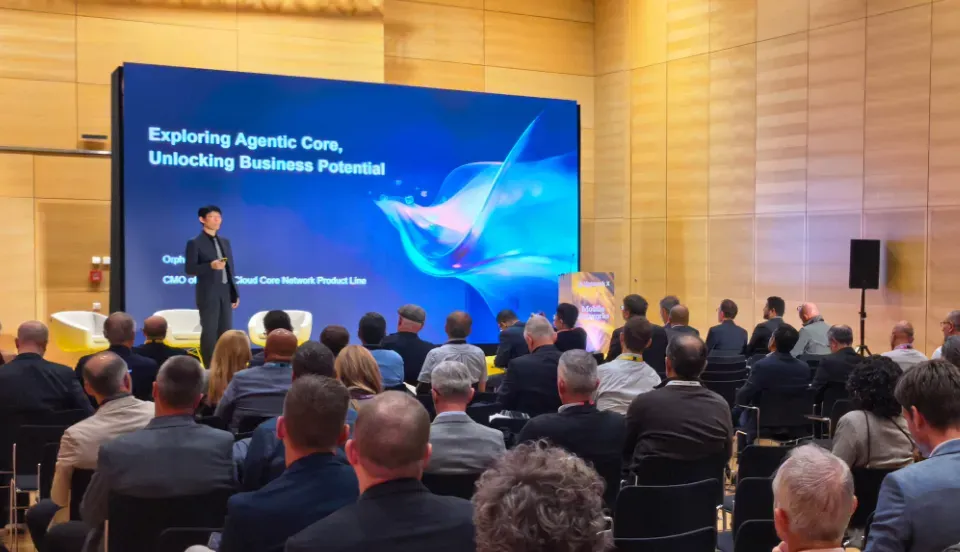
AI is rapidly evolving into an inclusive infrastructure, driving profound changes across the communications industry from three dimensions: connectivity, network construction, and user experience. Liu stated that traditional network architectures can no longer meet the new service requirements of the agentic era. However, operators can leverage their basic network capabilities to provide lightweight, accessible AI services to a wide range of industries.
Trend 1: The connection objects are changing, shifting from single connections to human-centric agentic communication networks.
The main entities of communication networks are evolving from traditional people and things to AI agents. It is predicted that by 2030, each person will have about 10 agents. Human-centric multi-agent collaboration will give rise to new services, such as AI task-driven dynamic networking and cross-domain agent identity authentication. However, the traditional signaling-driven communication mechanism cannot meet the requirements for efficient collaboration and interaction between agents.
To address this, Huawei has proposed a new network interaction model built on intent interfaces. This model enables networks to understand service intents, sense task requirements, terminal statuses, and resource conditions, fundamentally shifting from token transmission to task delivery. This will support the construction of an Agentic Communication Network (ACN).
Trend 2: The network construction logic is being reconstructed—shifting from content-centric to AI Data Center (AIDC)-centric, driving deep integration of computing and networks.
The demand for AI computing power is surging, and Internet enterprises are accelerating the deployment of distributed AI data centers. According to Orpheus Liu, network construction should also be evolved accordingly—shifting from a content-distribution-centric model to one centered on AI computing resources, enabling deep integration of computing power and networks.
At the same time, AI terminals are facing the challenge of balancing weight, battery life, and local computing power. Terminal computing power alone is insufficient to handle increasingly complex AI tasks. However, networks can supplement terminal computing power through offloading. Furthermore, a computing power scheduling mechanism based on Quality of AI Service (QoAIS) can enable collaborative optimization across computing power, networks, and terminals, scheduling the most appropriate resources nearby. This approach eliminates the computing power differences between terminals and delivers consistent AI service capabilities for all types of terminals.
Trend 3: Interactive experience is leaping forward—screen-based interaction gives way to immersive communication, opening up a new track for communication.
With the continuous breakthroughs in AR engineering technologies, immersive communication is expected to become the next-generation core communication entry point after smartphones, unlocking new service growth opportunities for operators.
Huawei pointed out that immersive communication consists of three core elements: spatial audio, holographic display, and multimodal interaction. To support this experience upgrade, the network must be equipped with underlying capabilities such as network rendering, intent awareness, multimodal synchronization, and dedicated transmission channels. Additionally, terminal-network synergy is required to provide a stable, smooth, and out-of-the-box immersive communication experience across terminals of varying specifications.
In the agentic era, Huawei AgenticCore evolves along three technical directions, driving the next-generation core network to evolve from Cloud Native to AI Native:
1.Pioneering intent interfaces: This marks an upgrade from traditional signaling connections to intent-based interaction based on AI tasks. The network can identify multi-dimensional terminal requirements, including content, networking, and computing power, and complete agent identity authentication synchronously, enabling more accurate resource matching and dynamic scheduling.
2.Deploying the Data & AI Plane (DAP): In addition to the original control plane and user plane of the core network, the Data & AI Plane (DAP) is introduced, along with three new types of network elements (NEs): intelligent, computing power, and data NEs. This improves the network's awareness of agent services and skill-based routing capabilities, supporting intent-based end-to-end resource orchestration.
3.From AI-assisted to AI-native network processes: AI decision-making is deeply integrated into the basic network processes, enhancing the task execution capabilities on both the control and user planes while providing native architecture support for agent services.
Orpheus Liu noted that the industry is rapidly building consensus around the next-generation core network architecture. International standards and industry organizations, including 3GPP, are actively advancing related technology research and standards evolution, offering a clear technical direction for core network development. The telecom industry needs to seize the development window of the AI Native era, proactively engage in building AI Native networks, and capture new opportunities for the next wave of industry growth.
At the same time, the evolution of the next-generation core network requires new infrastructure to provide a foundation. Orpheus Liu detailed the key roles of the telco cloud solution Telco Intelligent Converged Cloud(TICC) 2.0 and the intelligent O&M platform CORESpirit in the evolution to AI infrastructure. TICC 2.0 introduces an AI enablement platform and adopts a hyper-converged hardware architecture that integrates computing, networking, and storage, delivering diversified computing resources for agents and AI Native Network Functions (ANFs) while building a carrier-grade AI infrastructure foundation. CORESpirit promotes the evolution of network O&M from manual management to agent autonomy, implementing fault self-healing, automatic change handling, and SLA self-sustaining, and accelerating the upgrade of the core network toward autonomous intelligence.
In closing, Orpheus Liu stated that Huawei is ready to partner with all industry stakeholders to explore AgenticCore, build an end-to-end industry alliance, drive intent-based terminal-network synergy innovation, accelerate the development of new network capabilities, and jointly implement the AI Native architecture and technology evolution roadmap. He emphasized the need to continuously advance the next-generation core network and fully unlock service growth potential in the agentic era.