

At the 2nd AI Native Open Session, hosted by ETSI at the Pudong Shangri-La Hotel in Shanghai, George Gao, President of Huawei Cloud Core Network Product Line, delivered a keynote speech. He noted that 2026 marks a pivotal year for the telecom industry to move towards AI native. Reviewing the profound transformation of telecom networks driven by cloud native over the past decade, he proposed that the telecom industry should accelerate the formation of industry consensus to address the new service, connection, and terminal requirements posed by AI. He called for promoting the evolution of networks from cloud native to AI native through collaboration with CNCF, ETSI, 3GPP, and industry partners.
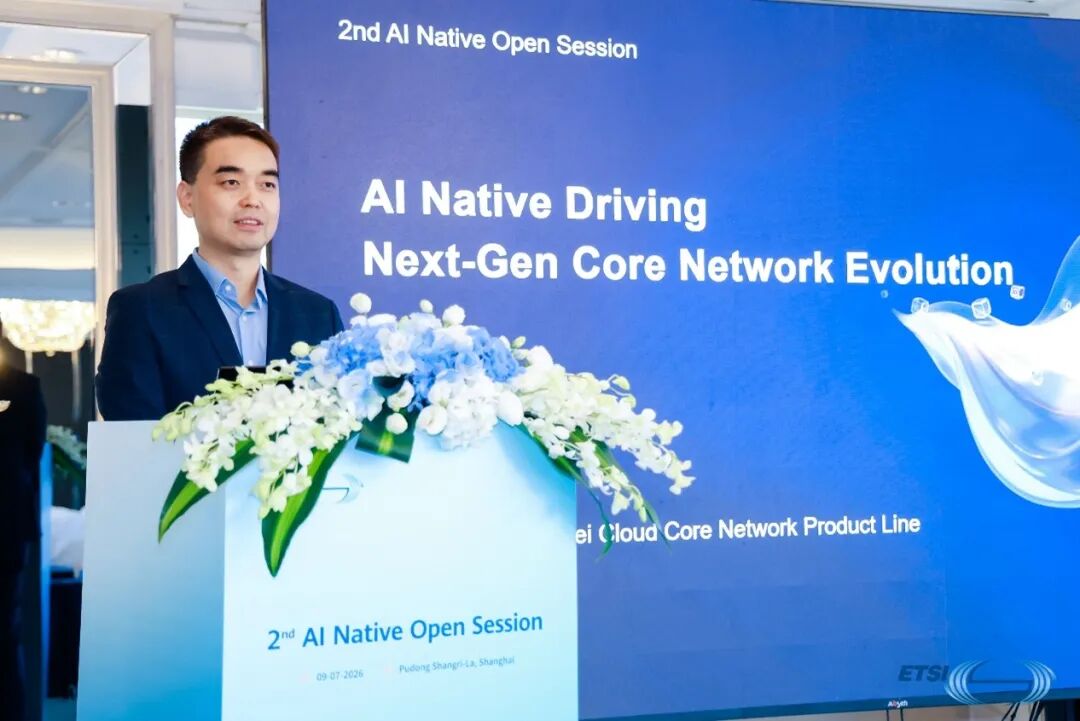
From Cloud Native to AI Native: Ushering in a New Era of Telecom Network Transformation
Mr. Gao noted that over the past decade, the core network has evolved from physical network functions (PNFs) to network functions virtualization (NFV), and then to service-based architecture (SBA), with cloud native being a critical foundation for telecom network development. Today, AI is emerging as the core driver of the next wave of network transformation. AI phones and wearables are rapidly gaining popularity, while AI agents are accelerating their integration into diverse applications. In the future, terminals and applications will pose not only conventional data transmission demands, but also massive requirements for real-time interaction, task execution, and intelligent collaboration. If networks remain confined to traditional connectivity paradigms, AI terminals and applications will fail to unleash their full potential.
Industry Collaboration Is Key to Moving Towards AI Native
Mr. Gao emphasized that the industry should carry forward the collaboration model of "standards+open source+industry practices" applied in the cloud native era to advance AI native networks. Specifically, CNCF promotes open source technologies and practices, ETSI conducts research on AI native infrastructure architectures, 3GPP advances the standardization of next-generation networks, and industry partners translate consensus and standards into feasible products and solutions. For next-generation core networks, AI native will drive three major transformations: the interaction between terminals and networks will shift from 'signaling' to 'intent', the core network architecture will transition from conventional functional designs to a new paradigm oriented toward task understanding and execution, and network capabilities will evolve from 'AI-overlay' to 'AI-native'.
From Bits to Tokens: Three Key Scenarios Drive Network Intelligence
According to Mr. Gao, over the next five to ten years, mobile networks will progressively transition from transmitting data (bits) to delivering task-oriented results (tokens), and will focus on three scenarios:
·Real-time interactive AI: Networks need to ensure low-latency AI interaction and dynamically orchestrate network resources based on user task intents.
·Wide-area distributed inference: Distributed computing power of vehicles and terminals should be fully utilized to dynamically schedule inference tasks to appropriate computing nodes.
·Agent communication: Networks need to comprehend task intents, as well as discover, match, and schedule required capabilities for diverse agents to enable cross-domain multi-agent collaboration.
These emerging scenarios will drive the evolution of network capabilities from traditional 'connection functions' to agent capabilities.
Promoting the Evolution Towards AI Native Core Networks in Two Phases
Regarding the future evolution path, Mr. Gao proposed a two-phase rollout:
In the first phase (2027–2028): Telecom infrastructure will be upgraded through the introduction of new capabilities, such as diversified computing power, high-speed parallel buses, and hyper-converged architecture; open-source technologies like security sandboxes and serverless will be leveraged to enhance service agility; and new network functions such as AI-native network functions (ANFs) will be gradually rolled out—all working together to meet AI service requirements.
In the second phase (2029–2030): As next-generation core network standards gradually mature, a carrier-grade agent platform tailored for AI agent workloads will be introduced to facilitate the seamless evolution of core networks from 'AI-overlay' ' to 'AI-native'.
Partnering with the Industry to Shape an AI Native Future
Mr. Gao stated, "2026 will be the year of building industry consensus, and 2027 will be the year of moving from consensus to standardization." Huawei will continue dedicating its efforts to and prioritizing its support for organizations including CNCF, ETSI, and 3GPP in AI native research, standards, and white papers. Huawei will also partner with global operators, open-source communities, standards organizations, and industry partners to jointly drive the telecom industry to spearhead AI-native transformation.