

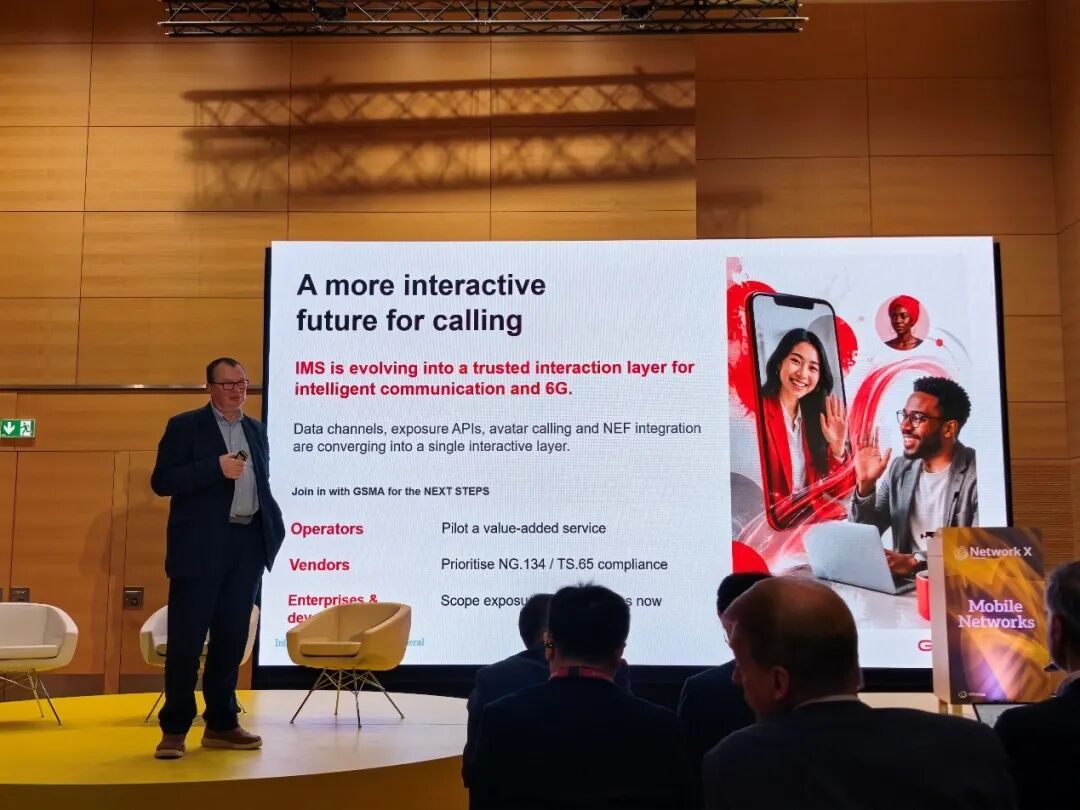
On October 13, 2026, at Network X 2026 in Vienna, Austria, Ian Pannell, GSMA Chief Engineer, delivered a keynote titled More Than a Call: IMS Data Channel and the Next Step for Operators. He shared industry insights on IMS DC’s technical evolution, innovative applications and monetisation opportunities. Pannell stated that IMS DC adds real-time data interaction capabilities to traditional voice services, transforming basic voice calls into intelligent interaction platforms and opening new avenues for operators to expand services and boost revenue.
IMS DC Adds Interactive Capabilities to Voice Calls
While VoLTE and VoNR have greatly improved voice quality, traditional voice revenue still heavily relies on call duration, calling for new service experiences and business models. IMS DC offers operators a practical path to build new services atop existing calling capabilities.
Defined by 3GPP, IMS DC creates a real-time data channel within IMS call sessions to enable integrated voice, video and data interactions. Users can access visual customer service, live captions & translation, information sharing and interactive transactions directly via the native phone calling interface, with no extra dedicated apps required.
Calls are no longer limited to voice conversations; they can support enterprise services and business transactions. Operators can launch new services beyond conventional voice and build differentiated communication offerings. As AI further integrates with calling, IMS DC supports AI assistants and eventually agentic services, advancing voice services into the AI era.
IMS DC Offers Three Routes to Monetisation
Pannell outlined three IMS DC monetisation paths: direct operator monetisation, B2B services & partners, and third-party developers.
Operators can deploy IMS DC value-added services such as real-time translation and AI assistants. Beyond standard voice tariffs, they can explore new pricing models based on interactive and intelligent features.
For B2B partners, Visual IVR, enterprise identity verification and mid-call content sharing can be used in customer service, enquiries and transaction processing. These tools help enterprises lift service efficiency and create new B2B cooperation opportunities for operators. Enterprise calling and customer service are high-potential areas for near-term IMS DC monetisation. Working with contact centres and CPaaS providers, enterprises can embed interactive forms and document sharing into call workflows to complete business tasks without hanging up.
For third-party developers, exposure APIs and development tools support the creation and integration of interactive calling applications, enriching IMS DC use cases.
Together, the three paths help operators extend voice service value from pure connectivity to broader service scenarios.
Tangible Progress in Standards and Commercial Deployment
IMS DC is backed by a mature standard ecosystem including 3GPP, IETF, W3C and GSMA. GSMA NG.129 covers IMS DC technology overview and industry vision; NG.134 defines deployment profiles; TS.65 specifies UE interoperability test cases and TS.66 defines the data channel API. These specifications lay a solid standards foundation for large-scale industry rollout.
GSMA Foundry, alongside China Mobile, Huawei and other partners, released a 5G New Calling white paper. China Mobile is building a nationwide 5G New Calling network, with real-time translation, fun calling and visualised voice calling gradually launched on live networks. IMS DC-powered interactive calling has achieved large-scale commercial deployment, and compatible end devices are available on the market. These deployments offer valuable experience for voice innovation and the broader IMS DC industry.
Challenges persist: fragmented support across chipsets and OSes, cross-vendor interoperability gaps, and lack of unified industry roadmap. Widespread IMS DC adoption requires joint efforts from device & chip vendors, OS providers, app developers and enterprise service platforms to align on device integration, SDKs, exposure APIs, app distribution and cross-network interworking. Priorities for the next phase include adopting unified specifications, strengthening device-network coordination and expanding the application ecosystem.
GSMA Calls for Further Industry Collaboration on IMS DC
Pannell noted IMS is evolving into a trusted interaction layer for intelligent communications and 6G. With the convergence of IMS DC, exposure APIs and avatar calling, legacy voice networks will support a richer set of intelligent interactive services.
GSMA will leverage standardisation, industry coordination and interoperability testing to align stakeholders and prevent siloed technologies and applications.
GSMA urges operators to pilot value-added services, vendors to prioritise adaptation and validation against specifications including NG.134 and TS.65, and enterprises & developers to explore exposure API use cases. Through closer cross-industry collaboration, IMS DC will move from a technical capability to widespread commercial adoption, unlocking new opportunities for next-generation communications.