

On November 26, 2025, the 5GC Core Summit convened in Bangkok. During the panel session "How to Build the Best Core Network for the AI Era?", Vangie Lampa-Alvarez from Globe Telecom, Kevin McDonnell of TM Forum (TMF), Diego Scalise of Telefónica Móviles Argentina, industry analyst Roberto Kompany, and Huawei's Eric Luo came together to exchange insights. The discussion highlighted cutting-edge practices and future directions for core network evolution across three dimensions: defining the best core network, shaping AI enablement strategies, and establishing standardized evaluation systems.
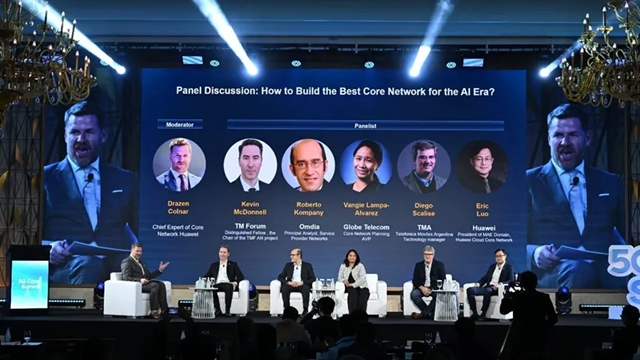
5GCS2025 Panel Discussion
Definition of Core Networks: Stability as the Foundation, Efficiency as the Driver
Diego Scalise of Telefónica Móviles Argentina noted that Argentina's passionate football culture often sparks 'signaling storms,' as millions of users generate instantaneous message traffic during major events. These surges underscore the vital importance of stability in network construction. He further noted that the flood of redundant alarms in legacy core networks places a heavy burden on O&M, making efficiency enhancements a key focus.
Vangie, representative of Globe Telecom, emphasized that frequent natural disasters such as typhoons and earthquakes in the Philippines pose persistent risks to network infrastructure. Given this situation, it is crucial to maintain a stable and resilient network to ensure service continuity during and after a disaster.
With the introduction of new container-based cloud platforms such as 5G SA alongside traditional systems, the operationalization of a multi-architecture environment has become increasingly complex. She emphasized the critical role of AI in managing this growing network complexity and accelerating the shift toward intelligent operations and maintenance (O&M).
Kevin McDonnell of TM Forum outlined three hallmarks of an ideal core network: stability under heavy load, predictability during network changes, and rapid recovery from faults. He called for a collaborative design approach that balances stability and efficiency, with clear boundaries for self-healing and autonomous control to prevent secondary risks from overreaction.
Eric Luo from Huawei, drawing on Huawei's ICNMaster intelligent O&M practices, highlighted how AI can deliver both stability and efficiency through four key transformations: O&M systems are shifting from an 'expert + tool automation' model to an 'AI agent + manual check' approach, moving from reactive response to proactive prevention. Interaction is evolving from man-machine to intent-driven agent-to-agent communication, enabling simpler, more intuitive management via natural language. Service processes are increasingly automated, reducing Time to Market (TTM) and Mean Time to Restore (MTTR). Integration is advancing from traditional southbound-northbound interface adaptation to Agent-to-Agent (A2A) or Model Context Protocol (MCP) adaptive interaction, boosting system efficiency.
AI-empowered Core Network: From Tool-assisted Execution to Agent-powered Autonomous Closed-loop Execution, Reshaping O&M Modes
Telefonica Móvil Argentina leverages Digital Twin technology to simulate signaling storms, enabling traffic trend forecasting and dynamic parameter optimization. This transforms traditional reactive response into proactive preventive assessment, effectively minimizing service interruptions. Its dual-agent system delivers a major leap in O&M efficiency: the Fault Handling Agent autonomously performs log analysis and performance evaluation, dramatically shortening fault locating time; meanwhile, the Complaint Handling Agent, powered by advanced natural language processing, identifies user intent and precisely matches issues with solutions. Together, these innovations drive substantial efficiency gains.
Globe is advancing its AI strategy within the core network while reinforcing system stability through the “5×3 independent region” architecture, improved efficiency through energy-saving policy decisions, and uninterrupted services during upgrades, among others. The company is prioritizing AI-driven predictive maintenance—using digital twins and failure-prediction models—as well as closed-loop assurance systems. A closed-loop assurance system is already deployed in the access network, while anomaly-detection capabilities for the core network are currently under pilot validation. By taking a measured approach that balances automation with operational stability, Globe is enabling resilient network evolution and delivering differentiated service experiences, even amid the Philippines’ challenging geographic landscape.
Huawei's ICNMaster intelligent O&M solution targets two key scenarios: fault management and network change. By leveraging a fault-handling agent and a service-assurance agent, the solution streamlines fault responseand manages routine alarms, incidents, and fault resolution. Having successfully established robust fault detection and analytical capabilities, Huawei is now poised to enhance its technological framework by strengthening the decision-making algorithms and autonomous execution functionalities within these agents. Beyond the current development trajectory of its intelligent agent ecosystem, Huawei has unveiled a roadmap for innovation. By 2026, the company aims to introduce a pioneering prototype: a dynamic network change agent powered by digital twin technology. This agent will enable intent-driven network planning and design coupled with sophisticated simulation and verification capabilities. Looking further ahead, Huawei is committed to collaborating closely with global operators to pioneer research in A2A and MCP. These initiatives are designed to facilitate seamless interaction among diverse intelligent agents, ultimately propelling the industry toward achieving Phase 2 objectives at Autonomous Networks Level 4 (AN L4).
Assessment Framework: Integrated Quantitative Metrics Driving Industrial Advancement
Kevin from TM Forum and analyst Roberto emphasized that establishing a unified benchmark for evaluating the 'Best Core Network' is essential. They also advocated for quantitative metrics, such as MTTR and automation rate, as the core dimensions to measure network autonomy levels. By adopting a standardized industry language and a common assessment framework, companies can work together to drive collective progress across the industry.
Conclusion
This panel brought together global operators and technology leaders to chart three key paths for core network evolution in the AI era: advancing stability and efficiency, transforming O&M through intelligent agents, and establishing unified industry standards through a standardized quantitative evaluation framework. With innovations such as digital twins and intent-based execution moving rapidly into practice, core networks are entering a new stage of being self-optimizing and predictive, laying the foundation for intelligent connectivity worldwide.