

Foreword
Each year, MWC is more than a stage for the world's leading technology enterprises to showcase cutting-edge achievements. The event serves as a catalyst where human wisdom and the spirit of innovation converge and resonate.
As we enter 2026, with 5G networks maturing, 6G development accelerating, and artificial intelligence (AI) continuing to evolve, a systemic transformation driven by connectivity technology and intelligent computing power is reshaping industries and the way society operates.
At MWC26 Shanghai, we engaged in in-depth conversations with representatives from multiple leading enterprises, seeking to understand the next phase of digital transformation and to provide forward-looking insights and reference points for the sustainable advancement of the global technology industry.
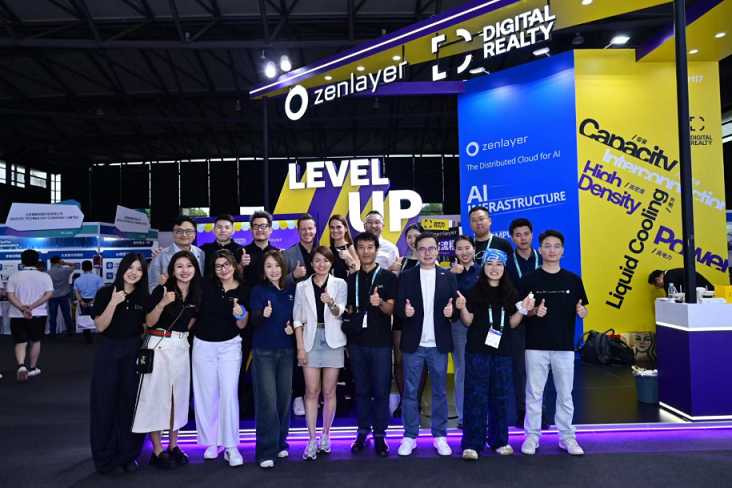
Themed ¡°The IQ Era,¡± MWC26 Shanghai took place from June 24 ¨C26. Digital Realty and Zenlayer partnered once again and offered a comprehensive showcase which demonstrated how companies can leverage AI data centers, hyper-connected networks, and distributed cloud platforms to deliver global, end-to-end infrastructure solutions.
During the event, Digital Realty's Head of Enterprise and Channels for Asia Pacific, Su Mu and Zenlayer's Vice President of Partnership and Alliance, Ashlee Yang shared their perspectives on how AI is reshaping infrastructure, and how both companies leverage their respective strengths to help customers seamlessly deploy, scale, and operate AI workloads across regions.

AI is Reshaping Infrastructure Demands
Over the past few years, AI has experienced explosive growth, with large models, AI agents, and other AI applications emerging in rapid succession. Related investments are also reaching record highs. As AI continues to evolve, the underlying infrastructure that supports it is undergoing profound transformation. From chips and power to network connectivity and data centers, every stakeholder in the value chain faces new demands and challenges.
¡°The rapid development of AI is fundamentally reshaping infrastructure demands,¡±said Su Mu. ¡°While the industry has historically focused more on models and applications, there is a growing recognition that realizing AI's commercial potential requires powerful infrastructure as its foundation.
Ashlee Yang explained that the energy shifts are driven by computing evolution.¡°Power consumption is growing at an unprecedented pace. A few years ago, 5 kW per rack was the industry norm. As graphics processing units (GPUs) have become the core driver of AI workloads, today's leading GPU platforms have already reached approximately 100 kW per rack¡ªand next-generation architectures are projected to reach 200 kW. That represents roughly 40 times growth in just a few years.¡±
Yet in her view, the true challenge of AI infrastructure lies not in building larger GPU clusters, but in connecting them more efficiently.
As new infrastructure tailored to high-density AI computing, including next-generation cloud provider facilities (NeoCloud operators) expands rapidly, network traffic is growing exponentially. The scale of data exchange between machines now exceeds the cumulative volume of historical human internet traffic.
In the AI era, the network is evolving from a traditional data transmission channel into a critical determinant of computing efficiency. This trend is especially evident in the Asia-Pacific region. To meet rising AI demands for computing and network capacity, markets including Singapore, Malaysia, Indonesia, and Thailand are ramping up infrastructure investment¡ªbuilding gigawatt-scale AI data centers, deploying new fiber networks and submarine cable systems, and accelerating the development of regional AI infrastructure hubs.

At the same time, AI workloads are changing. ¡°AI is shifting from centralized training toward distributed inference, with computing power no longer confined to a handful of core nodes. Conversations about AI often focus on the model or application itself. But in reality, it is the underlying infrastructure that truly determines whether AI can scale reliably,¡± Su Mu noted. Enterprises increasingly want to deploy inference capabilities closer to end users, with the flexibility to connect across cloud platforms, services, and ecosystem partners. To that end, we are expanding our AI-ready platform into high-growth markets such as Indonesia and Malaysia, while deepening our presence in Singapore, Seoul, and Japan, so that our AI-ready data center services can reach even more customers.
As AI inference moves toward distribution, the importance of the network's¡°last mile¡±take on critical importance. IDC projects that by 2027, more than 80% of enterprises will deploy distributed edge infrastructure to meet AI application demands for low latency, high concurrency, and high reliability. Ashlee Yang offered a real-world example: in the future, an AI agent completing a single task will often need to sequentially call multiple models and services. The latency a user experiences will no longer stem from a single request, but from latency that accumulates across multiple model calls. Today's notion of latency encompasses two dimensions: east-west (interconnection between models and data centers) and north-south (from models and data centers to users). In the AI era, the¡°last mile¡±has far outgrown its traditional definition. East-west interconnection shapes the end-user experience just as much as north-south connectivity, and is becoming ever more critical.
Two Roles, One Shared Goal
The rapid evolution of AI technology is reshaping the construction logic and evolutionary direction of data center infrastructure. Historically, the industry deployed data centers with a core focus on two foundational dimensions: space utilization and power supply. Yet as AI computing power achieves scaled deployment, customer infrastructure requirements have undergone a fundamental shift. They are increasingly favoring a new generation of infrastructure capable of sustaining ultra-high power density, supporting advanced communications capabilities, and delivering high reliability with large-scale, stable operating performance.
As AI chip computing power continues to scale, it unlocks ever greater processing capability while also generating intensifying heat dissipation pressure which is a core driver behind high-density data center construction and the broad adoption of liquid cooling technology today. The center of gravity for industry demand is shifting from basic resource supply toward specialized, high-density, highly adaptable infrastructure architecture that enables a comprehensive iteration of data center capabilities.
¡°Our global high-density computing (HDC) customization program helps customers plan with greater confidence as they transition their AI journey from the experimental stage to real-world deployment. One initiative we have introduced is Digital Realty's Innovation Lab (DRIL), which provides a real-time testing environment where customers can validate AI infrastructure, test the latest equipment and cooling solutions, and conduct proofs of concept before deploying in a live environment. This helps customers adapt to the rapid pace of technological iteration while reducing risk,¡±Su Mu explained.
¡°Digital Realty has already established our innovation labs in Ashburn, London, and Tokyo, and will expand to more regions in the future. We are delighted to have Zenlayer deploy their computing capacity within these labs to support customer testing.¡± At the same time, we combine localized deployment capabilities with global interconnect coverage. Through PlatformDIGITAL® and ServiceFabric® platforms, customers can seamlessly deploy and connect AI workloads across markets. Digital Realty currently operates more than 300 data centers across 55+ metros worldwide.
Zenlayer's role is distinctly complementary. Ashlee Yang noted that with the rise of NeoCloud operators, these providers deployed massive amounts of GPU hardware in facilities around the world and encountered a critical question:¡°How do I connect all of this?¡±Connectivity was often an afterthought and a bottleneck to deployment.
Ashlee emphasized that industry discussions about AI typically focus on what happens inside the data center. Outside the data center, however,¡°connectivity¡±is equally important. Most enterprises today still access AI services through the public internet, with inconsistent performance. To overcome this, the shift toward establishing private AI exchange platforms to sensure high-quality connectivity is becoming an industry imperative.
¡°This perfectly illustrates the complementary strengths of Digital Realty and Zenlayer,¡±Ashlee explained.¡°Digital Realty provides the core data center infrastructure¡ªthe processing hubs¡ªwhile Zenlayer establishes the private, low-latency connectivity routes between those hubs and destinations worldwide, creating a dedicated, stable pathway for AI traffic.¡±
Zenlayer's next-generation Fabric interconnect architecture enables enterprises to efficiently achieve cross-regional, cross-computing-layer, and cross-cloud connectivity, facilitating efficient global flow and low-latency coordination between models, data, and GPU clusters. Following a successful launch in Asia Pacific, this model is being replicated in Latin America, the Middle East, and other regions.
¡°Together, we offer an integrated solution that combines core data center capabilities with edge distribution and global connectivity,¡±Su Mu added.¡°This empowers enterprises to deploy AI workloads more efficiently through centralized training or distributed inference, while ensuring consistent performance across regions.¡±
Notably, Zenlayer has been named Digital Realty's Asia Pacific Partner of the Year for two consecutive years. In Ashlee Yang's view, ¡°Digital Realty and Zenlayer have demonstrated over the past two years that when computing and connectivity are co-designed, it leads to exponential growth and improvement.¡±
From Compliance to Experience, Enabling Global Expansion
Companies from various industries are moving quickly on global AI expansion, but they must carefully consider data sovereignty and local compliance, as regulatory requirements vary significantly across markets. At the same time, when serving global users, network latency and user experience become critically important.
¡°This was a common theme we observed at MWC26 Shanghai,¡±Su Mu explained. Global Readiness is increasingly drawing attention. At the show, many companies actively explored how to achieve international expansion, with conversations increasingly focused on cross-border infrastructure, compliance, and performance optimization.
As a global digital infrastructure operator, Digital Realty builds AI-ready data centers that support higher power density and advanced cooling solutions, while establishing a robust governance framework to ensure data quality, cleanliness, and security. For enterprises going global, Zenlayer provides standardized network and compute resources, enabling any enterprise expanding to a new region to plug directly into battle-tested, modular services without rebuilding from scratch and rapidly land its business in overseas markets.
¡°For companies still considering global expansion, our core recommendation is: build a scalable infrastructure strategy from day one, and choose partners who can both meet local needs and support global growth.¡±Digital Realty has over 300 data centers spanning more than 55 metros across more than 30 countries. When combined with Zenlayer's edge network coverage, the partnership of both companies provides integrated solutions for enterprises scaling AI infrastructure globally.
¡°This round of AI infrastructure buildout is just getting started,¡±Ashlee Yang noted. Zenlayer will deepen its presence in Asia Pacific and the Middle East by building private AI backbone network infrastructure, providing AI traffic with a dedicated, predictable, and high-quality transmission pathway. By deepening its partnership with Digital Realty and extending services from mature markets into emerging markets where AI demand is surging, Zenlayer is positioned to accelerate its global expansion.
Su Mu added, ¡°We believe that strong partnerships will play a pivotal role in shaping the next chapter of global AI infrastructure.¡±Looking ahead, both companies will deepen collaboration across platforms, from data center capacity to edge connectivity to service delivery, building an integrated, end-to-end infrastructure ecosystem.