

Families across China face a range of everyday care challenges. Many older people live alone, struggle to operate complex smart devices, and are at risk of loneliness. In dual-income households, parents are often busy at work, leaving children home alone after school. While smart devices are becoming increasingly widespread, older people, children, and other groups still face barriers to accessing AI services, highlighting a persistent digital divide. Meanwhile, busy middle-aged adults often struggle to find time to visit the gym or go to the cinema when they want to relax. They also need more convenient smart tools to help them work more efficiently.
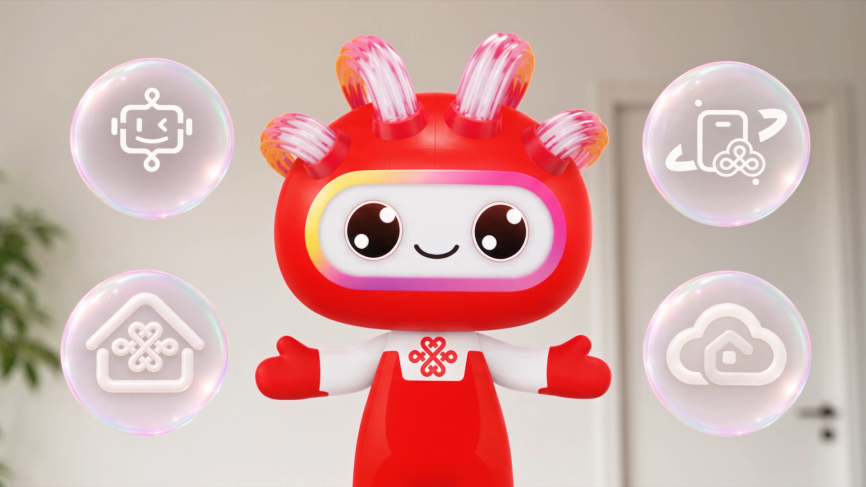
China Unicom has developed the Tongtong agent as a core AI engine to empower four cloud AI products: Unicom HomeMate, Unicom Cloud Disk, Unicom Cloud AI Phone, and Unicom Housekeeper. Together, these products bring accessible AI experiences with a human touch to everyday households.
For older people, the Tongtong agent replaces complex remote-control operations with voice-based interaction and can recognize more than 200 Chinese dialects. Voiceprint and facial recognition can identify individual family members and enable personalized content recommendations. Older users can initiate video calls on the big screen simply by speaking, while the camera automatically keeps them centered in the frame, allowing them to chat with family while doing household chores. Multimodal visual recognition can also detect falls at home and immediately alert family members and healthcare providers, helping improve safety for older people.
For children who are home alone, the agent offers companionship through picture-book reading, storytelling, general-knowledge Q&A, and exercise activities. It can automatically generate personalized learning plans, while its AI-powered homework grading achieves an accuracy rate of over 90%. Parents can remotely activate study support mode while away from home. Precious moments are automatically saved to the Unicom Cloud Disk and can be shared with family members across devices.
For middle-aged adults with both children and aging parents to care for, the Tongtong agent serves as an intelligent assistant that's always within reach. When users say, "I want to relax my shoulders," it can recommend tailored shoulder and neck relaxation exercises, acting as a personal fitness coach and turning the living room into a gym in seconds. When it's time to unwind, users can instantly launch games or movies on the big screen for an immersive experience. At work, users can simply use voice commands to draft proposals, plan itineraries, and book tickets, helping them boost efficiency.
The full suite of AI services costs just a few US dollars per month. Three core technologies make this inclusive AI experience possible. SIM-based identity binding establishes a trusted identity for the agent. A unified memory system synchronizes preferences across devices, enabling the AI to understand each family member better and deliver increasingly personalized assistance over time. A device-cloud collaboration architecture brings flagship AI capabilities to entry-level devices.
To date, the Tongtong agent has served 400 million household users across China, helping generate hundreds of millions of US dollars in additional revenue. In Hebei, it has helped increase ARPU for home services by more than US$11. Looking ahead, China Unicom will continue to enhance the Tongtong agent and extend its reach to remote areas and people with disabilities. The company has also shared best practices with more than 10 operators worldwide, with the aim of bringing caring, trustworthy AI services to more families around the world.