

The 77th International Astronautical Congress (IAC 2026) opened on October 5 in Antalya, Türkiye. Final Frontier Technology Co., Ltd. ("Final Frontier") presented its latest technologies and products at the congress.
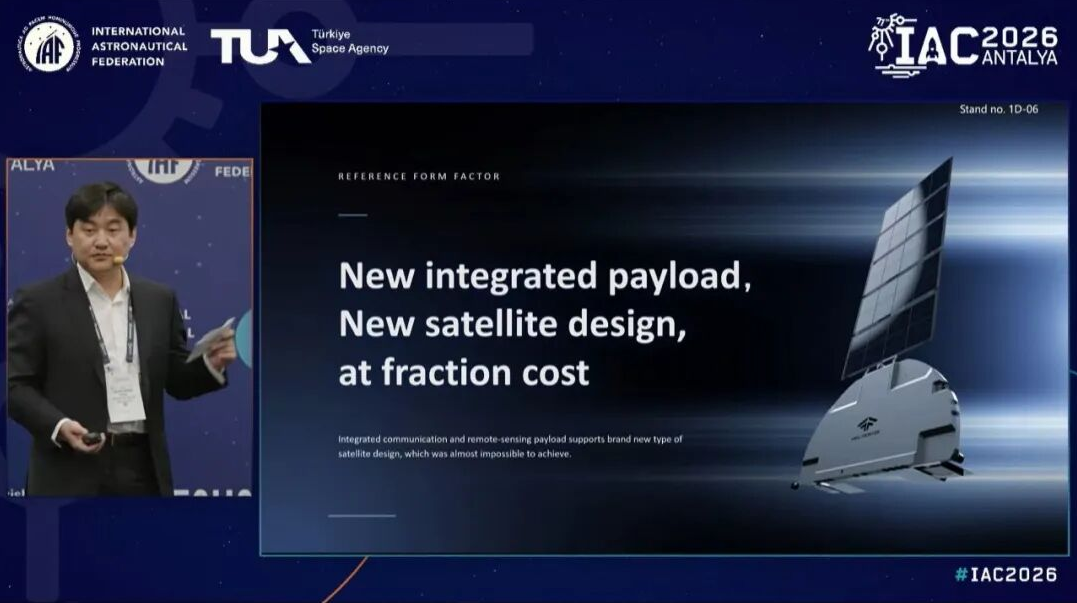
Speaking at the IAF Global Networking Forum, company founder and CEO Derek Chen delivered a talk titled "From Phased Array Antenna to Software-Defined X", systematically setting out the company's technology evolution path from phased array antennas and a centralized computing platform to software-defined payloads, and officially launched IBRS (Intent-Based Remote Sensing), an intent-based remote sensing data service, in its global debut.
Built around on-board computing, IBRS shifts data processing and information generation upstream, onto the satellite itself, exploring a transition in global remote sensing services from obtaining imagery to obtaining information, and marking a new phase for commercial satellites: computing in orbit.
From Ground-Based Computing to In-Orbit Computing, Breaking Through the Bottleneck of Conventional Data Processing
Conventional remote sensing satellites are primarily data collectors: massive volumes of imagery are downlinked over satellite-to-ground links, then processed on the ground and analyzed manually before results emerge. As the volume of remote sensing data continues to surge, the limits of downlink capacity and ground processing have become a major constraint on service efficiency.
IBRS seeks to deploy computing and analysis capabilities fully on the satellite. Users simply describe their mission objectives, and the system completes task planning, image acquisition and intelligent processing in orbit, returning task-oriented information directly.
This model breaks the old chain of "satellite collects, ground processes" and makes a leap toward a new one: sensing in orbit, computing in orbit, information delivered directly. The satellite is no longer merely a courier of raw imagery but directly takes on data processing and information generation, effectively turning space data into higher-value information products.
Synergizing Architectural Innovation and Advanced Manufacturing, Building a Foundation for Next-Generation Space Intelligence
The agility of IBRS as a service rests on the system-level foundation Final Frontier has built around its centralized computing platform and software-defined payloads.
In the talk, Final Frontier not only presented its technology evolution path but also explored in depth how communication and remote sensing payloads operate together under a unified computing architecture. To make this architecture possible, the company drew inspiration from its phased array work and made a breakthrough in creating its proprietary "Optical Fusion" technology, successfully re-engineering the traditional bulky, barrel-style optics into a compact optical unit highly integrated into a flat-panel satellite. This core technology makes genuine integration of communication and remote sensing payloads possible, allowing both mission-critical capabilities to coexist on a single flat-panel satellite, and enables large-batch launches of 60 to 80 satellites per rocket. On this centralized architecture, new tasks can be continuously defined and extended on orbit through software updates, providing a highly flexible technical base for new forms of space information services.
This step up in underlying capability would not be possible without the breadth and depth of China's manufacturing ecosystem. In the talk, Final Frontier gave particular emphasis to the strong support China's manufacturing system provides for the industrialization of space products. From RF chips and antennas to computing, software and payload thermal design, a complete industrial chain provides a solid foundation for taking technical solutions from methodology to engineered products, allowing space hardware to be designed, built and rapidly iterated at close to an industrial cadence. Final Frontier is bringing this manufacturing dividend together with architectural innovation, moving space intelligence products in earnest from laboratory validation to deployment at scale.

Task Results in Minutes, Extending Remote Sensing to Every Domain
Closing the computing loop in orbit gives remote sensing information services unprecedented timeliness. By removing the redundant downlink of large volumes of raw imagery and the lengthy ground processing that follows, IBRS compresses the time to high-value information from days to minutes.
In sudden events such as wildfires, floods and maritime anomalies, rapid access to key remote sensing information gives responders critical time for assessment and rescue — time that can save lives. In high-frequency scenarios such as economic activity monitoring, resource surveys and macro-level analysis, delivering task-oriented findings directly will also greatly raise the responsiveness of the global space information network.
From seeing to understanding, and from delivering imagery to delivering information, the launch of IBRS marks a breakthrough exploration by Final Frontier toward the next generation of space information services. Its presence at the International Astronautical Congress not only demonstrates the bold innovation of Chinese commercial space companies in on-board computing, software-defined satellites and space-based intelligent sensing, but also shows the world that China's space products are moving steadily into a new era of global service.